 |
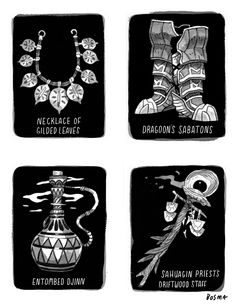
Sam Bosma, Inventory
|
A continual challenge I find in RPG writing is how to represent a place that's chock full of fantastical or magical junk - Howl's bedroom and Hogwart's Room of Requirement are high profile examples, but any antique shop, ancient library or wizard's workroom fit the bill as well. Places that are full of a disorganized over-abundance of interesting stuff. They're easy to represent in visual art (draw a lot of cool stuff), or in fiction writing (describe the general clutter and pick out a few examples) but difficult to do in the context of a game because it puts a high cognitive load on the DM to describe interesting objects and because players have a reasonable expectation that they should be able to poke around in there and actually pick up and use what they find. I suspect that this is why most dungeon rooms are comparatively bare, or thoroughly ruined with only a few important objects.
Another trouble area is how to represent "minor" magic. Usually what you get is some combination of pure flavor effects (things that are weird but totally useless and/or non-interactive) and weaker versions of existing magical effects (which are often more mechanically complicated - for example, a sword that is +1 to hit but only in certain situations).
My table naturally commits some of both of these sins!
Notes: the table was written with the
GLOG in mind, but it's obviously pretty rules light. I'll add links to other tables as they appear on the blog.
 |
Kamome Shirahama, Witch Hat Atelier
|
1-10. Book: Each book has a title and an X-in-6 chance of containing useful information on any problem relating to its title. Determine X by rolling 1d4.
11-15. Potion: roll on the Potions table
16-20. Herb: roll on the Useful Herbs table
21-25. Scroll: roll on the Spell table
26. Candied Chestnuts: A Glantri street-vendor specialty. Nobody else makes them quite as well.
27. Box of Cigars: Produce clouds of pungent purple smoke. A box contains six cigars and is decorated with the image of a woman representing one of the four seasons
28. Sackful of Feathers: The most fantastic colors imaginable
29. Fire Powders: Cause a fire to flare up, emit sparks, and burn in a variety of bright colors. You never know when you might need to impress somebody.
30. Colored Spectacles: All the rage amongst the fashionable set, these come in a variety of colors. Cool blue, lime green, and rosy pink are currently the most popular.
31. Rainbow Snail: Fed on sugar, lettuce, and small pieces of fruit. Occasionally makes soft farting sounds. The secretions can be used to make a wonderful color-changing ink.
32. Pair of Jeweled Scissors
33. Antique Teacup: When placed onto its matching saucer, a simple spell sculpts the liquid in the cup into an image of some kind (sleeping dragons and floral designs were popular.
34. Glass Globe: An illusory fish appears inside when the globe is filled with water.
35. Canary: A useful creature for dungeon explorers and magical researchers alike. Not only is a canary sensitive to bad air, it will change color when exposed to strong magic.
36. Prism Stone: Available in a variety of colors, these stones shed light like a candle
37. Singing Frog: A few years back there was quite a fashion for enchanting frogs to sing popular ballads. Unfortunately the spells bred true, and now you can pick up singing frogs by the bucketful in any city canal, all lustily croaking out songs that are years out of date. The frogs remain popular as gag gifts, however.
38. Large, Sour-Tempered Toad: Absolutely no magical utility whatsoever.
39. Small Jewelry Box: Made from turtle shell, contains fish eggs.
40. Book of Pressed Flowers: Useful when identifying magical plants. Contains three Useful Herbs, which use a d4 Magic Dice.
41. Kaleidoscope: When looked through, coruscating colors surround the user.
42. Set of Colorful Juggling Balls: If you get them going, they can juggle by themselves for 1d6 rounds.
43. Deep Blue Piece of Flint: When struck with steel it produces a small jet of water.
44. Fireworks
45. Dog: Small, white, and curly-haired, the dogs of Glantri are not especially hardy or imposing, but they are intelligent, brave, and amusing companions.
46. Brass Orb: A strange curio, bought at a bargain price from a tiny antique shop. It produces a humming sound and the smell of camphor oil when struck. The harder it is struck, the louder the hum and the stronger the smell. Comes with a small silver mallet.
47. Stone of Warmth: A flat stone that radiates a pleasant warmth. Usually placed under blankets or kept in a coat pocket for added warmth.
48. Terrarium: Layers of soil and pockets of gold dust and rock crystal simulate a miniature dungeon environment, sustaining a colony of sprites. Can be used to cultivate one sample of a Useful Herb or Fungi per downtime phase.
49. Cricket in a Cage: While the borderlanders raise and battle beetles for sport, crickets are all the rage in Glantri. Kept in specially shaped boxes and jugs that acoustically amplify their songs and raised on special diets, a prime Glantrian cricket can sell for as much as a good horse. While crickets are prized primarily for their songs, the fiercest crickets often sound the best as well, and you can enter your cricket in
grub-tumbling matches if you choose. Roll 1d6: 1-3, Mountain Fiddler (1d6); 4-5, Green Bell-Bug (2d6); 6 Royal Silvergrig (3d6).
50. Winged Hat: The symbol of a warlock, a member of a martial order of magicians. Each order has its own particular emblem and color - the Redwings, the Crossed Wands, the Order of the Thistle, the Keepers of Gulltower, etc.
51. Seashell Charm: Contains a heartfelt spell of safety. Grants +4 to a single save, then breaks.
52. Miniature Red Trumpet: Perfectly reproduces the cries of a dragon when played correctly.
53. Loyal Candle: Only the person holding the candle benefits from its light. If you hold someone's hand, they can see the candle's light as well.
54. Stone Pets: An embroidered bag of brightly polished stones that have been enchanted to be as intelligent as mice. If released they will roll about on the floor amusingly for several minutes before retiring to their bag to rest.
55. Soup Stone: Boil it with nothing but water and it will produce a thin broth of no particular flavor (restores 1 Fatigue if this is the full meal). When used in a Feast, it counts as an ingredient but contributes no Nutrients.
56. Enchanted Cookpot: Keeps food fresh indefinitely.
57. Hawking Bat: wears a hood (for light-sensitive eyes) and tether. Used for hunting the large moths that flock to Glantri's many lamps. Comes with leather gauntlet, nectar-soaked lure, and silent signal whistle.
58. Loyal Coin: A largish copper coin. When separated from its owner, it will attempt to return. Useful for small scams, but the coin rolling off in pursuit of its master can be conspicuous. If trapped for a week or elaborately praised and petted it will change loyalties.
59. Paper Cutouts: Enchanted slips of paper that momentarily transform in to real versions of the things they depict are a popular amusement among students at Glantri's magical academies. 1d6 Cutouts per stash (1d6): 1) riding horse; 2) fountain; 3) beautiful woman; 4) fish supper; 5) huge pigeon; 6) heap of jewels. Each lasts for 1d6 minutes (or until touched) before turning to smoke.
60. Eversmoking Bottle: Produces great quantities of perfumed, sparkling smoke when the stopper is removed, which pours from the bottle and totally obscures vision within 50 feet after 1 round. If the bottle is left unstoppered, the smoke spreads another 10 feet per round until it has spread out to 100 feet.
61. Owl Figurine: When tapped once on the head and told to "Wake Me," it will hoot softly at a specified time. When tapped twice on the head and told to "Watch," it will screech if danger approaches.
62. Opal Earring: Chimes and flashes when a spell is cast nearby. Considered somewhat gauche.
63. Hat of Disguise: When worn, your face changes to look like one specific person (a comically ugly bearded man is traditional)
64. Sleeping Draught: A restorative - the drinker receives double the usual benefits of a night's rest, but cannot be woken early.
65. Weather-Charmed Umbrella: For when you want to carry your own weather with you. When opened, produces one specific type of weather under its shade (d4): 1) light rain; 2) heavy snow; 3-4) sun.
66. Jar of Bluebell Fire: Bluebell flames are loyal to one particular person and will not burn them, so they can be picked up and moved about by hand.
67. Deck of Tarot Cards: The hand-painted figures move on their own. Can cast Augury at 20 + INT%
68. Pair of Tiny Bells: Each will ring whenever its sibling does.
69. Feathered Cloak: Reduces fall damage by half. In Glantri, feathered cloaks are associated with adulterers, who supposedly use them to leap out of windows to escape jealous spouses, and with people who lack confidence in their ability to use Soar Shoes.
70. Basilisk Skull-Stone: This slick black stone produces a mild high when held under the tongue. Dissolved in alcohol, it will cure petrification.
71. Dust of Tracelessness: When rubbed on the feet (shoes, paws, wheels, hooves, etc.) this dust prevents the wearer from leaving any footprints or tracks. Dust lasts for 1d6 hours of hard travel before it must be reapplied, or half as long in wet areas.
72. Dust of Sneezing & Choking: When you throw a handful of the dust into the air, you and each creature that needs to breathe within 30 feet of you must save or become unable to breathe while sneezing uncontrollably. When a creature runs out of breathe or is choking, it can survive for a number of rounds equal to its CON modifier (minimum of 1 round). At the start of its next turn, it drops to 0 HP and is dying, and can't regain HP or be stabilized until it can breathe again.
73. Dust of Disappearance: Any object or person thoroughly coated with the dust becomes invisible. The dust can still be inadvertently brushed off, washed off, etc.
74. Dust of Illusion: When sprinkled with this dust, a creature or object appears to become something else of similar size and shape. An unwilling target is allowed a save to avoid the dust. The illusion lasts for 2 hours or until the dust is washed off.
75. Periapt of Proof Against Poison: a small grey-green stone on a thin silver chain, which chimes in the presence of poison.
76. Jeweled Cloak Pin: Made of filigree and colored glass in the shape of a winged animal. Can be detached and animated to carry letters.
77. Paired Silver Rings: One set with a red stone, the other with a blue one. Small points of light in the depths of each stone continually point in the direction of the ring's mate.
78. Beautiful Violin: Has four enchanted strings. Can play a tune that charms all who listen, but causes one string to break after 1d6+1 rounds.
79. Magician's Purse: Larger on the inside, it can store up to three significant items. An unfashionable antique often associated with rich old ladies and poor young bohemians.
80. Fireproof Cloak & Gloves: Commonly woven of thick wool treated with ossip wax and spells, but the very best are made of wyvern-hide. Reduce fire damage by 2.
81. Bottled Forest: When spilled over a surface, it engenders an overgrowth of grass, moss, flowers, and ivy. Deals 3d6 damage if drunk.
82. Swap Boxes: Two small chests about a hand's length across, with hasps in the shapes of impish faces. Whenever you lock them, their contents swap.
83. Sound Jar: Very small opaque glass jar, slightly heavier than you would expect. When opened, it produces the sound of (d6): 1) a string quartet; 2) a fashionable dinner party; 3) a scream of perfect horror; 4) waves on the beach; 5) footsteps; 6) someone reciting a poem
84. Immovable Rod: When the button is pushed, the rod does not move from its position, even if staying in place defies gravity.
85. Extensible Rod: A short silver baton that can extend up to 10 feet long on command.
86. Horn of Fog: An ancient horn, elaborately carved and hanging from a cracked leather strap. Produces a cloud of thick fog that obscures all sight beyond 5 feet when blown.
87. Primal Clay: Sculpted forms come to life, as a 1 MD use of Form Familiar.
88. Blasting Chime: a heavy iron handbell, deals damage as a crossbow when rung.
89. Silver Scale Armor: A relic of Glantri's martial past, every scale of this ancient suit of armor is inscribed with a spell to ward against blade and arrow.
90. Decanter of Endless Water:
91-93. Magic Compass: Place a focus inside of this glass globe, and it will point your way to the nearest example of that thing. For example, if a gold coin were placed inside of it, the compass would point to the nearest cache of gold.
94-96. Elemental Coin: A large brass coin, stamped with an elaborate seal and set with 1d4 small colored gems. When offered in ritual payment, the coin vanishes and an elemental appears as if a Summon spell had been cast with a number of MD equal to the gems set into the coin. The color of the gem determines the type of elemental called (d6): 1) amber - gnome, 2) red - salamander, 3) white - sylph, 4) blue - undine, 5) purple - wisp, 6) green - merlish sapling.
97-99. Soar Shoes: Half of a magic circle is inscribed on the sole of each shoe, allowing the wearer to fly when they click their heels together. Flight is tricky to get used to: beginners must make a Reflex check to control their flight and a Reflex save if attempting something particularly tricky (such as staying in the air after taking damage). Every three downtime actions spent practing, gain +1 to flying checks, to a maximum of +4.
100. Duello Monster Cards. A collectable card game of impenetrable complexity. The cards depict various monsters, and include little monster facts. A given set is worth 3d6 x 10. Monster facts have a 50% chance of being both true and useful. A deck usually contains around 21 monster cards (18 + 1d6). Mark off the monsters that you have established facts for.
Sidebar: Playing Duello Monster Cards: Games are resolved with opposed Intelligence checks, modified by the strength of the deck and type matchup. Roll 3d6 to determine the deck's starting modifier, and 1d4 for its type:
1) Aggro: Advantaged over Control
2) Control: Advantaged over Combo
3) Combo: Advantaged over Tempo
4) Tempo: Advantaged over Aggro
Score | Modifier
1 | -5
2-3 | -4
4-5 | -3
6-7 | -2
8-9 | -1
10-11 | +0
12-13 | +1
14-15 | +2
16-17 | +3
18-19 | +4
20-21 | +5
22-23 | +6
24-25 | +7
26-27 | +8
28-29 | +9
30 | +10
 |
Howl's Moving Castle
|


